
The Quick Answer
Your newborn’s first doctor visit in Idaho Falls, Idaho typically takes place within 3 to 5 days after birth (or shortly after hospital discharge). During this visit, your pediatrician will measure your baby’s weight, length, and head circumference; perform a full physical examination; assess feeding and jaundice; and answer any questions you have as a new parent. It is one of the most important well-child visits in your child’s first year.
Bringing a new baby home is one of the most exciting and, let’s be honest, nerve-wracking things a parent can experience. You are figuring out feeding schedules, decoding cries, and surviving on very little sleep, all while trying to make sure your little one is healthy and thriving. One of the first things you will need to do after leaving the hospital is schedule your newborn’s first doctor visit.
If you are a new parent in Idaho Falls, Idaho, this guide will walk you through exactly what to expect so you can walk into that appointment feeling informed and calm rather than overwhelmed. At Just 4 Kids Pediatrics, we have been partnering with families in eastern Idaho for over 25 years, and we know that the more prepared you feel, the better that first visit goes for everyone.
When Should a Newborn See a Doctor for the First Time?
The American Academy of Pediatrics (AAP) recommends that newborns have their first doctor visit within 3 to 5 days of birth, or within 48 to 72 hours of hospital discharge if your baby was born early or had any feeding concerns. For most healthy, full-term babies, this means you will be calling to schedule that appointment before you even leave the maternity ward.
Why so soon? In the first few days of life, newborns can lose some of their birth weight, and jaundice, feeding difficulties, and other concerns can appear quickly. That early check-in gives your pediatrician a chance to catch anything that needs attention and gives you a chance to ask all those questions that have been piling up since you got home.
Choosing a Newborn Doctor in Idaho Falls, Idaho
Before that first appointment can happen, you need a pediatrician. Ideally, this is a conversation you have during your third trimester, not after you are home with a three-day-old. Many families in the Idaho Falls area schedule a prenatal consultation with a pediatric practice to meet the providers and ask questions before their baby arrives.
At Just 4 Kids Pediatrics, we welcome prenatal visits because we believe that relationship between parent and provider starts long before baby’s first breath. You can learn more about why choosing a dedicated pediatrician matters and what sets pediatric specialists apart from general family medicine providers.
We have three convenient locations to serve families across eastern Idaho:
- Eagle Drive Office — 3067 Eagle Drive, Ammon, ID 83406
- Pancheri Office — 1645 Pancheri Drive, Idaho Falls, ID 83402
Rexburg Office — 1236 Bond Avenue, Suite B, Rexburg, ID 83440
All locations can be reached at (208) 522-4600.
What Happens at Your Newborn’s First Doctor Visit
Here is a detailed, step-by-step look at what you can expect during your baby’s first pediatric appointment.
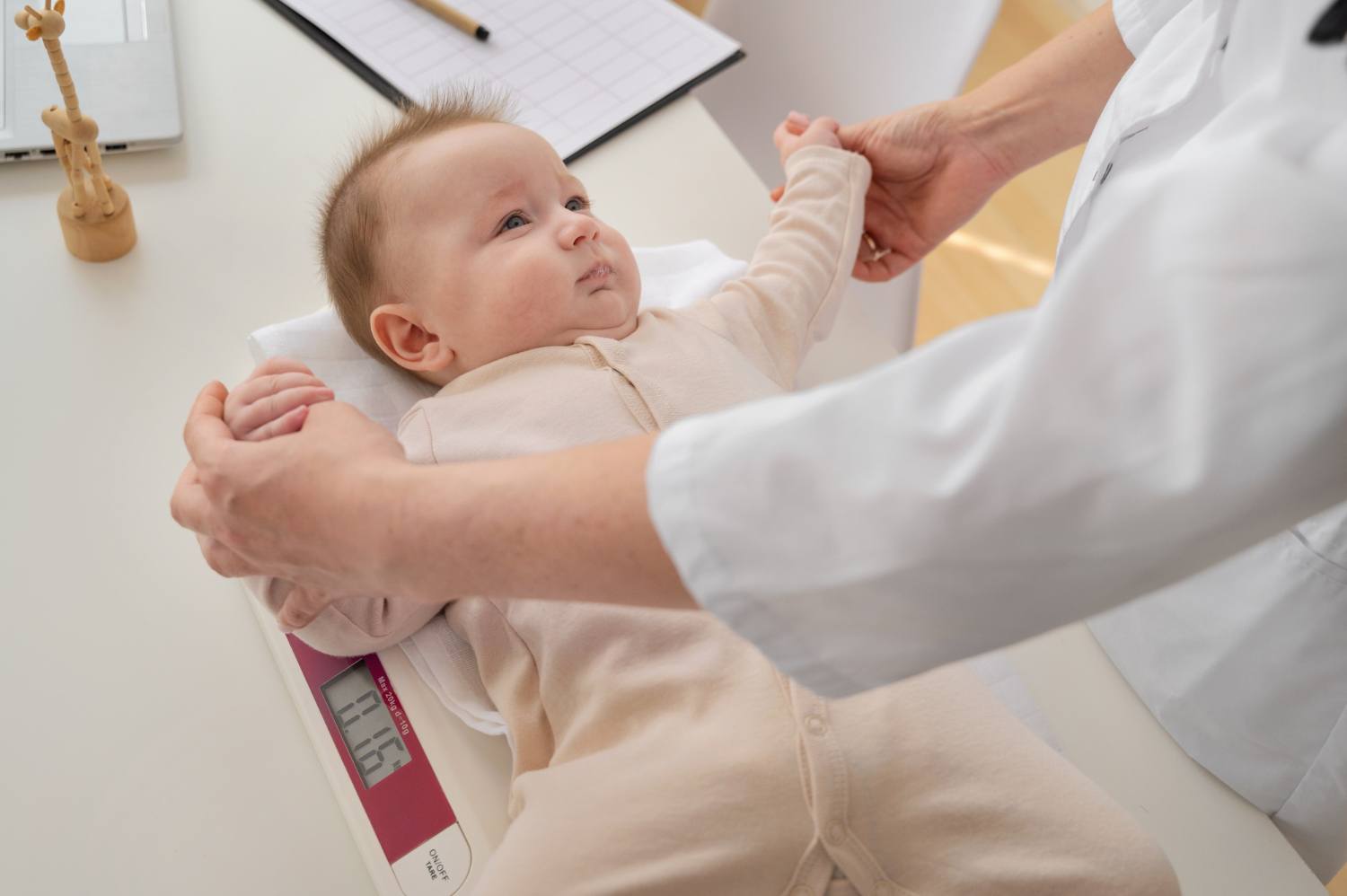
1. Weight, Length, and Head Circumference Measurements
The visit usually begins with a nurse taking your baby’s measurements. Your baby’s birth weight from the hospital will serve as the baseline, and your pediatrician will track weight gain and growth from this point forward. Most newborns lose a small amount of weight in the first few days after birth before they begin gaining. Your provider will evaluate whether your baby’s weight is on track and trending in the right direction.
These numbers are plotted on a growth chart, which is one of the most useful tools in pediatrics. It is not about where your baby ranks compared to others. It is about whether your individual baby is growing consistently along their own curve.
2. A Head-to-Toe Physical Examination
Your newborn’s doctor will perform a thorough physical examination from head to toe. This includes:
- Head and fontanelles — The soft spots on your baby’s skull will be assessed for size and firmness.
- Eyes — Checked for a normal red reflex, which helps rule out serious conditions like congenital cataracts.
- Ears, nose, and mouth — The palate will be checked for a cleft, and ears will be examined for normal structure.
- Heart and lungs — Your pediatrician will listen carefully for any murmurs or abnormal breath sounds.
- Abdomen — The umbilical cord stump will be examined, and the liver and spleen will be gently palpated.
- Hips — A careful assessment of hip stability is performed to check for developmental dysplasia of the hip (DDH).
- Genitalia — Normal development is confirmed. In boys, the testes are checked to ensure they have descended properly.
- Spine and skin — Your provider will look at skin color, birthmarks, rashes, and the alignment of the spine.
- Reflexes and muscle tone — Primitive newborn reflexes, such as the Moro reflex, rooting reflex, and grasp reflex, are assessed.
Neurological behavior — Your doctor will observe how alert, responsive, and active your baby is.
This exam gives your provider a complete picture of your baby’s baseline health.
3. Jaundice Assessment
Jaundice, or hyperbilirubinemia, is extremely common in newborns. It causes the skin and whites of the eyes to appear yellowish, and it results from an accumulation of bilirubin in the blood as the newborn’s liver adjusts to life outside the womb. Your pediatrician will visually assess your baby and may order a bilirubin level if there is any concern. Mild jaundice often resolves on its own, but more significant levels may require phototherapy treatment.
4. Feeding Evaluation
Whether you are breastfeeding or formula feeding, feeding your newborn is often one of the most stressful parts of new parenthood. This visit is an ideal time to raise any concerns, including:
- Whether your baby seems satisfied after feedings
- How many wet diapers and bowel movements your baby is producing per day
- Latch difficulties or nipple pain if you are breastfeeding
- How much formula your baby is taking and how often if you are formula feeding
Signs of possible reflux or milk protein intolerance
Your pediatric team can help you troubleshoot feeding challenges and, if needed, refer you to a lactation consultant for additional support.
5. Review of Newborn Screening Results
Before leaving the hospital, your baby underwent newborn metabolic screening, a hearing test, and pulse oximetry screening. Your pediatrician will review those results with you at this visit. If any results require follow-up, your provider will explain next steps clearly and calmly.
6. Umbilical Cord and Circumcision Care
Your provider will check the umbilical cord stump and give you guidance on keeping it clean and dry until it falls off, typically within one to three weeks. If your son was circumcised, the healing site will also be examined and care instructions will be reviewed.
7. Parental Guidance and Education
This portion of the visit is just as important as the physical exam. Your pediatrician will cover topics such as:
- Safe sleep practices (back to sleep, firm mattress, no loose bedding)
- Car seat safety
- Normal newborn behavior and what symptoms warrant a call to the office
- Fever guidelines for newborns, which are different from older children
- Vitamin D supplementation for breastfed infants
When to expect the next well-child visit
Do not hesitate to bring a written list of questions. There are truly no silly questions at this stage, and your pediatric team wants to hear them all.
8. Scheduling the Next Well-Child Visit
The newborn visit is just the beginning of a well-child schedule that follows your baby closely through the first year and beyond. After this first appointment, your baby will typically be seen at the following milestones: 1 month, 2 months, 4 months, 6 months, 9 months, and 12 months. Starting at the 2-month visit, your baby will begin receiving vaccinations according to the AAP and CDC-recommended immunization schedule.
What to Bring to Your Newborn’s First Appointment
Being organized before the visit will make things go much more smoothly. Here is what to pack:
- Your baby’s hospital discharge paperwork, including birth weight and newborn screening results
- Your insurance card and any required referral information
- A completed new patient form (you can fill this out ahead of time)
- A list of any medications your baby has received
- A list of your questions and concerns
- Diapers, wipes, a change of clothes, and a pacifier if your baby uses one
- A feeding log if you have been tracking feedings and diaper output
What to Expect After the Visit
You will likely leave the appointment with a lot of information. That is completely normal. Your provider may recommend:
- A follow-up visit within a few days if there were weight or jaundice concerns
- A specific feeding plan or formula recommendation
- A referral to a specialist if any findings warrant further evaluation
Instructions for a specific symptom to monitor at home
If you have questions after you leave, do not wait. Call the office. Just 4 Kids Pediatrics offers extended hours Monday through Friday from 8 AM to 8 PM and Saturday from 9 AM to 6 PM so that you have access to answers when you need them.
Red Flags: When to Call Your Newborn’s Doctor Before the Scheduled Visit
While the first well-child visit is planned, there are times you should call your newborn’s pediatrician right away, regardless of your scheduled appointment. These include:
- Rectal temperature of 100.4°F (38°C) or higher in a baby under 2 months old — this is a medical emergency and requires immediate evaluation
- Yellowing of the skin spreading to the legs or becoming very pronounced
- Fewer than six wet diapers in a 24-hour period after day 4 of life
- Difficulty waking your baby for feedings
- Unusual crying, limpness, or a high-pitched cry that does not seem normal
- Bleeding, redness, or discharge from the umbilical cord stump or circumcision site
Any breathing that looks labored, very fast, or involves the nostrils flaring
When in doubt, call. Use our Symptom Checker as a helpful starting point, but always reach out to a provider for newborn concerns. Newborns can change quickly, and your instincts as a parent matter.
Why Just 4 Kids Pediatrics Is the Right Choice for Your Newborn

Just 4 Kids Pediatrics is one of the most established and trusted pediatric practices in eastern Idaho. Our board-certified pediatricians and caring staff specialize exclusively in the care of children, from newborns through adolescents. We are not a general family practice or an urgent care that also sees kids. We are a dedicated pediatric home for your child, and that specialization makes a difference.
Our providers are parents themselves. They understand the weight of the responsibility you are carrying, and they bring both clinical expertise and genuine compassion to every appointment. Families across Idaho Falls, Ammon, Rexburg, and the surrounding communities have trusted us for over 25 years for exactly that reason.
When your newborn needs a doctor in Idaho Falls, Idaho, we are ready to be your partner from day one. Meet our team of providers and find the right fit for your family.
Frequently Asked Questions: Newborn Doctor Visits in Idaho Falls, Idaho
What age is considered a newborn for doctor visits?
A newborn is generally considered to be a baby from birth through 28 days of life. During this period, well-child visits are scheduled more frequently because newborns are undergoing rapid physiological changes and require close monitoring.
How do I choose a pediatrician for my newborn in Idaho Falls?
Look for a board-certified pediatrician who practices exclusively in pediatric medicine, accepts your insurance, and has convenient office hours. Consider scheduling a prenatal consultation before your baby is born so you can meet the provider and ask questions ahead of time. Just 4 Kids Pediatrics welcomes prenatal visits and is happy to help your family get started.
Does my newborn need vaccines at the first visit?
Typically, no vaccines are given at the very first newborn visit (3 to 5 days). The Hepatitis B vaccine is usually given in the hospital at birth. The 2-month well-child visit is typically when the first round of additional vaccines begins. Review the recommended vaccine schedule to understand what is coming and when.
What if my baby loses weight before the first visit?
Some weight loss in the first few days after birth is completely normal. Most babies lose up to 7 to 10 percent of their birth weight before they start gaining. Your pediatrician will assess the amount of weight lost and evaluate feeding to determine whether it is within the expected range or whether additional support is needed.
Can I call with questions before the first appointment?
Absolutely. Just 4 Kids Pediatrics encourages new parents to call with any concerns at any time. You can reach all three of our locations at (208) 522-4600. For non-urgent guidance between visits, our Symptom Checker is also a helpful resource.
Will my insurance cover the newborn’s first visit?
Most health insurance plans, including Medicaid and most private insurance plans, cover well-child visits at no cost to you under preventive care benefits. However, coverage varies by plan, so it is always a good idea to verify your benefits before the visit. Learn more about billing and insurance at Just 4 Kids Pediatrics.
What if I have not chosen a pediatrician before leaving the hospital?
Do not panic. Call Just 4 Kids Pediatrics as soon as possible after getting home. Let the front desk know your baby’s birth date and that you need to establish care and schedule a newborn visit. We will work to get you in quickly. You can also complete our new patient form online to speed up the process.
Is it normal to feel overwhelmed at the first newborn visit?
Yes, completely. Most new parents feel a mix of exhaustion, relief, and anxiety all at once. Our team is here to support you as well as your baby. There is no question that is too small or too basic. Your wellbeing as a parent directly affects your baby’s wellbeing, and we take that seriously.
Disclaimer: This content is intended for general informational and educational purposes only. It does not constitute medical advice and should not replace the guidance of a qualified, licensed healthcare provider. Always consult your child’s pediatrician with specific health concerns or questions about your individual child’s care.